Dust Collection Since 1994

News

Types of Industrial Dust Collectors and Their Applications

十二月 08, 2020

Industrial production processes can generate many different types of dust and particulate matter. Because dust characteristics and operating conditions vary between applications, there is no single dust collector suitable for every production process. Understanding the main types of industrial dust collectors can help buyers select more appropriate equipment.


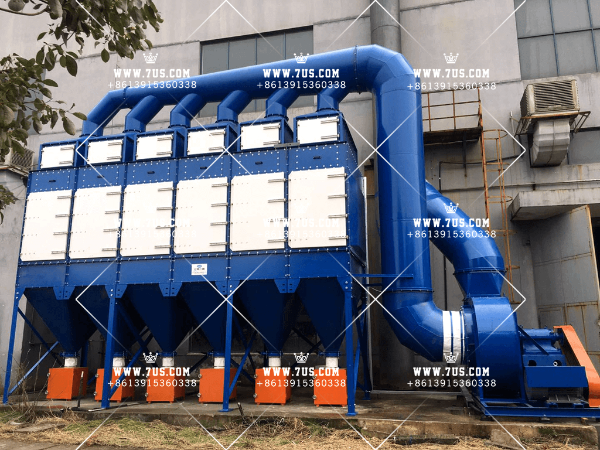
Industrial dust collector for manufacturing applications

The selection of an industrial dust collector should be based on factors such as dust type, particle characteristics, dust concentration, airflow, operating temperature, moisture or oil content, and safety requirements.

1. Cartridge Dust Collectors

Cartridge dust collectors use pleated filter cartridges to provide a large filtration area within a relatively compact structure. They are commonly used for fine and dry dust generated by processes such as grinding, cutting, powder handling, and other industrial operations.

Pulse-jet compressed air is commonly used to clean accumulated dust from the filter cartridges and help maintain stable filtration performance during operation.

You can view our vertical cartridge dust collector for dry industrial dust collection applications.

2. Baghouse Dust Collectors

Baghouse dust collectors use fabric filter bags to separate particulate matter from dust-laden air. They are widely used in industrial applications with relatively high dust loading and can be configured with different filter media according to dust characteristics and operating temperature.

Our baghouse dust collectors can be configured for different industrial dust collection applications according to the required airflow and operating conditions.

3. Cyclone Separators

Cyclone separators use centrifugal force to separate larger and heavier particles from the airflow. They do not normally rely on filter cartridges or filter bags and can be used as primary dust collectors or pre-separators before a secondary filtration stage.

Cyclone separators can be particularly useful where the incoming dust contains a significant proportion of coarse particles or where reducing the dust loading on downstream filters is desirable.

4. Wet Dust Collectors

Wet dust collectors use water to capture and separate particulate matter from the airflow. They can be considered for certain applications involving combustible metal dust, oily particles, or other dust conditions where wet collection is more appropriate than dry filtration.

The suitability of wet collection should be evaluated according to the actual dust characteristics, process conditions, wastewater handling requirements, and applicable safety requirements.

How to Select the Right Type of Dust Collector

Selecting between cartridge, baghouse, cyclone, and wet collection technologies should not be based only on equipment size or purchase price. Important technical information should be confirmed before equipment selection.

This information normally includes required airflow, dust type, particle characteristics, dust concentration, operating temperature, moisture or oil content, installation environment, electrical supply, and any combustible dust or explosion protection requirements.

In some industrial applications, more than one dust separation technology may also be used. For example, a cyclone separator can be installed as a pre-separator before a cartridge or baghouse dust collector to reduce the amount of coarse dust reaching the final filtration stage.

Jiangsu Erhuan Environmental Technology Co., Ltd. manufactures industrial dust collection equipment and filtration products under the 7US brand for international markets. Our product range includes cartridge dust collectors, baghouse dust collectors, wet dust collectors, cyclone separators, industrial filter cartridges, and related filtration components.

OEM and private-label manufacturing services are available for overseas distributors, engineering companies, system integrators, and equipment manufacturers.

Learn more about 7US industrial dust collection equipment.

BACK
PREV

Why Industrial Dust Collectors Are Important in Manufacturing

NEXT

How Does a Grinding Dust Collector Work and How Should You Maintain It?