
十二月 08, 2020
An EHWD wet dust collector uses water as the scrubbing liquid to capture suitable industrial dust from the airstream. As dust-laden air passes through the specially designed internal flow channel, the airflow creates intensive contact between the dust and the water, allowing particles to become wetted and transferred into the water tank.
Unlike a dry dust collector, a wet dust collector does not rely on filter bags or cartridges for the primary dust-capture process. The appropriate collection method should be selected according to the dust properties, operating temperature, moisture content, airflow and project requirements.
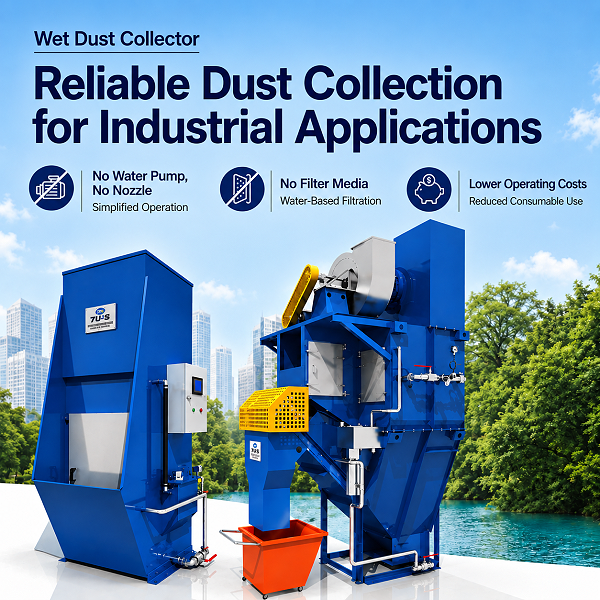
1. Suitable for demanding dust conditions: Wet dust collection can be considered for selected hot, humid, oily, sticky or high-dust-loading process air streams. These conditions may quickly blind dry filter bags or cartridges in some applications.
2. Self-induced wet scrubbing: The EHWD design uses high-velocity airflow to create turbulent water waves for primary dust capture. A recirculation water pump and spray nozzles are not required for the main scrubbing process.
3. Reduced filter-media maintenance: Because the primary collection process does not use cartridges or filter bags, the system can reduce maintenance associated with dry filter media in suitable applications.
4. Cooling and humidification effect: Wet collection can help cool hot process air while transferring collected dust into the water. Additional gas-treatment stages may be considered when required by the actual process.
Collected dust is transferred into the scrubbing water and discharged as slurry or sludge. The appropriate discharge method depends on the dust loading and material characteristics. EHWD configurations can use continuous mechanical sludge discharge or valve-controlled slurry discharge for connection to external treatment equipment.
Scrubbing water can be recirculated, with make-up water used to compensate for evaporation and sludge discharge. Where necessary, external solid-liquid separation equipment can be considered to recover solids and return clarified water to the wet dust collector.
Wet dust collection is not suitable for every dust type. The collected material, possible reaction with water, corrosion conditions, wastewater treatment requirements and operating temperature should be evaluated before equipment selection.
For certain combustible metal dust applications, wet collection may be considered only after assessment of the specific dust properties and project safety requirements. Any required hydrogen venting, electrical protection and additional safeguards should be determined for the complete system.
Learn more about the EHWD self-induced wet dust collector for industrial dust collection applications.
 Products
 Industries
 OEM/ODM
 News
News About us
 Contact